🎃 31-10-2023 Halloween update: Añadida recopilación de artículos 2009, la mayoría de los articulos pertenecen a la primera parte del periodo. pues la mayor parte de los SLR se encontraban en ese periodo, tan solo
tengo que mirar la situación de los articulos que ya se encuentran y su situación en cuanto a licencia se refiere
Analizame estos artículos y dimes cuales pueden ser los mas interesantes de cara
¡Let’s travel around a SLR in the field of sustainability to demonstrate how can we get the big picture from 0!
Introduction
In The Antilibrary: why unread books are the most important of “The Black Swan,” Nassim Taleb explains the importance of the books one owns but hasn’t read yet, using the example of how Umberto Eco accumulates thousands of these on his shelves and how they can be helpful. It’s a reminder of our limitations and bears witness to the knowledge we have yet to explore. Also, let’s not kid ourselves, sometimes it’s important to know what NOT to read.
Building an antilibrary can be great for getting a sense of names, conventions, trends, facilitating brainstorming, and accessing new ideas. Having a library to dip into like a pool of new adventures.
We are going to evaluate sustainability in the green technology sector, particularly from a software and engineering perspective. We will be reviewing papers that aim to improve cloud infrastructure, conducting research on prerequisites, and exploring new ideas or methods to reduce carbon emissions… A long list, however, take into account that this particular research can draw parallels with different fields if you consider a different topic.
Knowing the perspective of academia, even though it may be detached from the industry, is always a good starting point to consider.
What is a Systematic literature review?
When we start studying an unfamiliar branch of knowledge, it can be interesting to take a look at this type of articles to save time and have a model of what is out there.
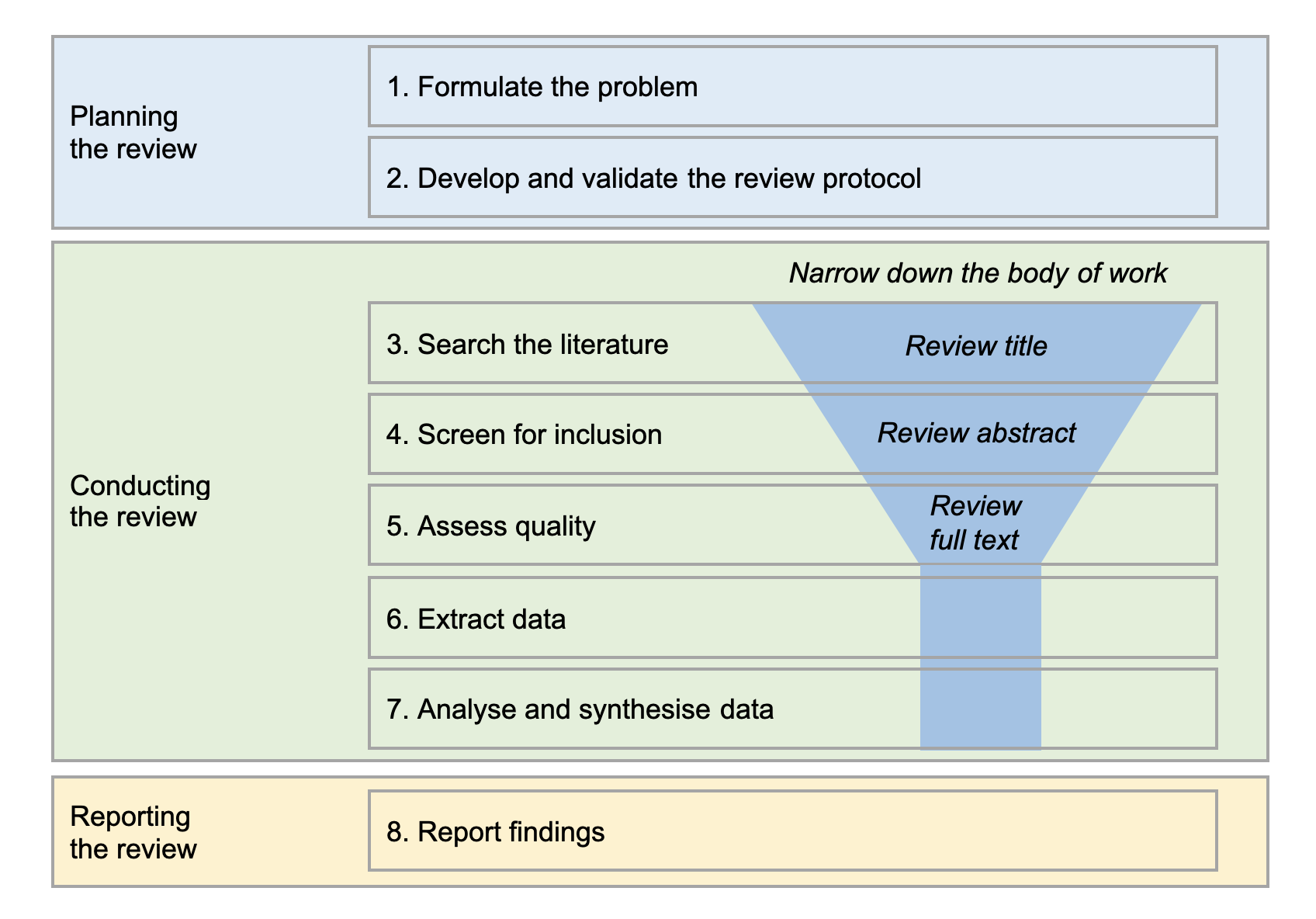
In the following article you will find 8 different articles from which I have extracted the map of the scientific world out there. To do this, I first tried to search online, mainly using websites of scientific publications, such as:
- Elsevier
- Scopus
- Springer
- …
In my case, once I obtained the most recent SLR, I tried to follow the thread and extract from it works that may have been done previously, and then go back to using the search engines in case I had missed other relevant works.
Once I have a collection, I do two readings, the first one is a quick scan, glancing over the articles to see what I was going to encounter, in the second one I do a more careful reading with my highlighter, where I note in yellow the ideas and articles relevant to this work and in purple those that seem interesting to me beyond the topic I am researching.
I had problems with highlighting in the Mac app, I have lost the highlighting and notes on two occasions, which has obviously been somewhat discouraging to continue with the collection. Ensure that the highlighting is working before wasting hundred hours.
Once we have analyzed the articles, I have extracted a collection of articles interesting for my research and particularly relevant to me, which can be seen in the last sections.
The idea is to have a database to go to with my own questions. Something relevant to keep in mind with this type of publication is that sometimes there is a very large gap between scientific work and published work and the business efforts and capabilities of the industry. For various reasons, this can be large or smaller depending on the topic to study.
0. 2023 Requirements engineering for sustainable software systems: A systematic mapping study
1. 2012 Penzenstadler
2. 2014 Ahmad
3. 2014 Penzenstadler 2
4. 2017 Characterising Sustainability Requirements: A New Species, Red Herring, or Just an Odd Fish?
5. 2017 Wolfram
## 6. 2019 Imran
7. 2020 Berntsen
⚠️ I am aware that I have missed another SLR, Mourão BC, Karita L, do Carmo MI (2018) Green and sustainable software engineering: a systematic mapping study. I did not find the article in the public domain and therefore have dismissed it.
What we can get from all of those?
Once I have compiled all the relevant articles found in the works in this dataset, which contains 135 papers. Of course, it’s possible that not all of them will be useful for a particular research or to propose certain development. But here the concept of the antilibrary gains importance. We have a small dataset to draw from when we need it or when we are stuck.
They are organized alphabetically as follows:
| Year | Author | Title |
|---|---|---|
| 2013 | Koziolek et al. | A lightweight method (MORPHOSIS) |
| 2013 | Gu, Q., Lago | A Categorization of Green Practices Used by Dutch Data Centers. |
| … | … | … |
| 2013 | Liangli et al. | Virtualization Maturity Reference Model for Green Software |
| 2013 | Penzenstadler et al | Who is the advocate? Stakeholders for sustainability. |
Note: During the reading of all these articles, I realized that giving your work a name is incredibly powerful, just as I remember the name Penzenslader after having seen it numerous times, having searched for his face and this talk on the internet. I don’t forget “GreenSoft” or the “Morphosis model” each time I see it.
To demonstrate the utility of this work, we are going to make a small table with interesting studies that we can find in this review of reviews:
| Year | Author | Title |
|---|---|---|
| 2014 | Chen, F., Schneider | An Energy Consumption Model and Analysis Tool for Cloud Computing Environments. In: Proceedings of the First International Workshop on Green and Sustainable Software |
| 2019 | Theresia Ratih Dewi | Analyzing Trade-offs for Sustainability Requirements: A Decision-Making Process |
| 2011 | Sasikala | Architectural strategies for green cloud computing: environments, infrastructure and resources |
| 2016 | Christophe Ponsard | Guiding Cloud Application Developers toward a Balanced Design Trade-off among Energy Impacting Requirements |
| 2012 | Johann et al. | How to measure energy-efficiency of software: Metrics and measurement results |
| 2015 | Kocak | Integrating environmental sustainability in software product quality |
| 2010 | Bahsoon | A Framework for Dynamic Self-optimization of Power and Dependability Requirements in Green Cloud Architectures |
| 2013 | Heiko Koziolek | MORPHOSIS: A Lightweight Method Facilitating Sustainable Software Architectures |
| 2013 | Gu, Q., Lago | A Categorization of Green Practices Used by Dutch Data Centers. |
| 2013 | Penzenstadler | A generic model for sustainability with process- and product-specific instances |
| 2020 | Theresia Ratih Dewi | Addressing sustainability in the requirements engineering process: From elicitation to functional decomposition |
| 2013 | Chen, Kazman | Architecting ultra-large-scale green information systems |
| 2013 | Mahaux et al. | Integrating the complexity of sustainability in requirements engineering |
| 2007 | McIntosh et al. | database design for ecologists including observation data |
| 2020 | Theresia Ratih | Integrated framework for incorporating sustainability design in software engineering life-cycle: An empirical study |
| 2020 | Manal Kharbouch | Software Requirement Catalog on Acceptability, Usability, Internationalization and Sustainability for Contraception |
| 2021 | Maike Basmer | Susaf welcomes susapp: Tool support for the sustainability awareness framework |
| 2018 | Ahmed D | SuSoftPro: Sustainability Profiling for Software |
| 2018 | Norbert Seyff | Tailoring Requirements Negotiation to Sustainability |
| 2020 | Nelly Condori-Fernandez | Toward a non-functional requirements discovery approach for persuasive systems |
And that is all, after doing this work you realize that it might not be necessary for all types of projects, but it is interesting to understand how a Systematic Literature Review works and how to approach a review of reviews, at least to have it as a tool. The works found might not be useful in themselves, but they can still provide ideas, and one should not dismiss everything in them even if they do not reach an interesting conclusion.
If I were to start over again, what would I do?
This work is licensed under the Creative Commons Attribution-ShareAlike 4.0 International License. To view a copy of this license, visit http://creativecommons.org/licenses/by-sa/4.0/
# Bonus extra:
Me: Analizame estos artículos y dimes cuales pueden ser los mas interesantes a leer para obtener nuevas ideas de software sostenible.

ChatGPT:
Last modified on 2023-07-10
Comments Disabled.